Guide
Do I need to change my consumer unit?
Not every consumer unit needs replacing, but old fuseboxes without residual current protection, or damaged units, usually do. Here is how to tell.
- Send a short enquiry
- Covering Essex
- EICR and related services
You do not always need to change your consumer unit, but you probably should if it is an old fusebox with rewirable fuses, has no residual current device (RCD), is damaged or overheating, or has been flagged in an electrical report. A qualified electrician can look at your electrical installation and tell you whether a consumer unit upgrade is needed or whether the existing unit can stay.
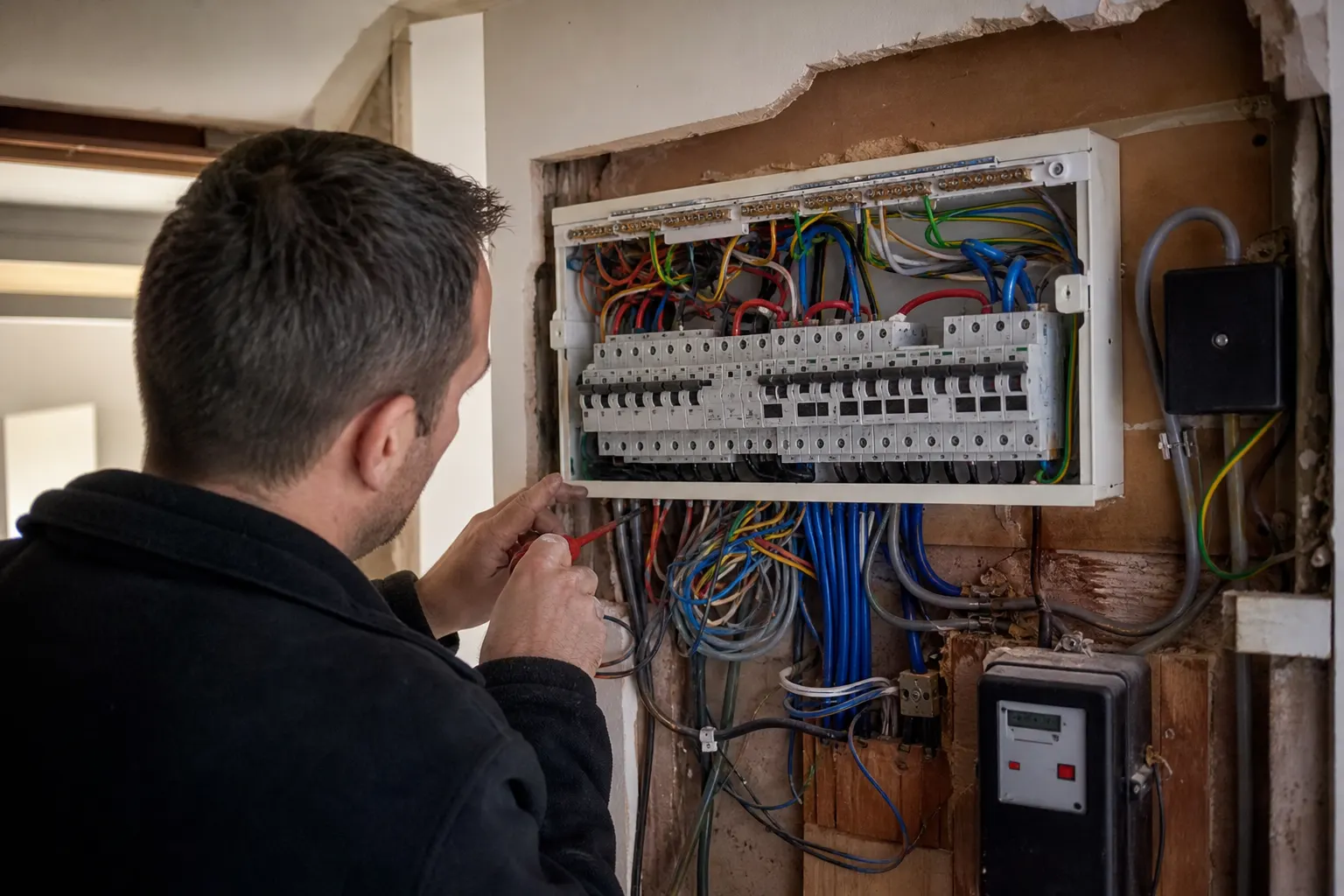
Signs your consumer unit needs replacing
Some things are fairly clear warning signs. If your fusebox has porcelain fuse holders with wire you have to replace by hand, it belongs to an older generation of equipment and is a strong candidate for replacement.
Other signs include a cracked or broken cover, scorch marks, a burning smell, buzzing or crackling, fuses or breakers that trip repeatedly for no obvious reason, and switches that feel loose or hot. Any of these means you should stop and get an electrician to look at it soon. Do not open the unit yourself.
Why residual current protection matters
A residual current device monitors the current flowing in a circuit and switches off very quickly if some of it leaks to earth, for example through a person. That is why an RCD is such a valuable protection against electric shock and fire.
Many older fuseboxes have no RCD at all, or only protect a single circuit. If you are wondering whether you need to change your consumer unit without an RCD fitted, that is one of the most common reasons an electrician will recommend an upgrade. A modern unit combines RCD protection with miniature circuit breakers (MCBs), which switch off a circuit when it is overloaded and are easier to reset than replacing fuse wire.
When you can probably leave it alone
Old does not automatically mean unsafe. If your unit uses miniature circuit breakers, has suitable RCD protection, is in good condition, and your electrician has tested the circuits and found no concerns, replacement may not be necessary.
The point is that this is a judgement made after inspection and testing, not from the age of the box alone. Many modern units also have a plastic enclosure. Many newer ones are made with a non-combustible enclosure, so an electrician may mention that when comparing options, but it does not mean every older unit must come out straight away.
Other times a change becomes sensible
A consumer unit replacement is often recommended when other work is planned. If you are adding circuits for a kitchen, an extension, an electric vehicle charger or a heat pump, the existing unit may not have the space or the protection needed. Fitting new equipment into an unsuitable box is not good practice.
An electrical installation condition report (EICR) can also point towards an upgrade. If the report lists observations about the consumer unit, such as missing RCD protection or a damaged enclosure, take them seriously and ask the electrician to explain which are urgent. Landlords and buyers often come across this when a property changes hands or is let, so it helps to find out early.
If you are asking whether there is an alternative to rewiring, note that a new consumer unit is not a rewire. Replacing the unit deals with the protection and switching at the board. Whether the cables themselves are in good order is a separate question that testing will answer.
What affects the cost
Costs vary from job to job, so ask for a written quote rather than relying on a general figure. An electrician may price a consumer unit upgrade as a fixed price for the job, or by an hourly rate plus parts, and some add a callout fee. Ask which applies and what is included.
The things that usually move the price are the type and size of the new unit, how many circuits need connecting, and whether the unit is in an awkward spot such as under the stairs or in a cramped cupboard. The condition of the existing wiring matters too. If testing finds faults that need fixing before the new unit can be safely connected, that adds time and materials. Time of day, the need to arrange a power shutdown, and how long the work takes also play a part. A clear quote should list the parts, the labour and any extras, and say what happens if extra work turns up.
Choosing who does the work
Consumer unit work is not a DIY job. It involves the main supply and needs testing once it is finished. Ask any electrician about their qualifications and registration, and ask what paperwork you will receive when the job is complete. Rules and guidance can change, so check GOV.UK for the current position on notifying and certifying electrical work in your home.
EICR Benfleet covers Benfleet and the wider Essex area for consumer unit upgrades, and can talk through what your own set-up needs.
Common questions
Do old consumer units need to be replaced?
Not automatically. A unit in good condition with suitable RCD protection and circuit breakers may be fine. Old fuseboxes with rewirable fuses, no RCD, or visible damage are the ones most often recommended for replacement.
How much does it cost to change from a fuse box to a breaker box?
It depends on the unit chosen, the number of circuits, access, the condition of the existing wiring and how long the work takes. Ask for a written quote that lists parts, labour and any callout fee.
Do I need to change my consumer unit if I have an RCD already?
Not necessarily. If the unit is undamaged, protects the circuits appropriately and has passed testing, it may stay. An electrician can confirm whether it suits any new work you are planning.
Can I change my consumer unit myself?
It is not recommended. The work involves the incoming supply and must be tested properly afterwards. Use a qualified electrician, and check GOV.UK for the current rules on electrical work in homes.
Useful sources
- NICEIC: The electrical contracting body, with a register to check an electrician.
- Electrical Safety First: The UK charity for electrical safety, with consumer guidance.